
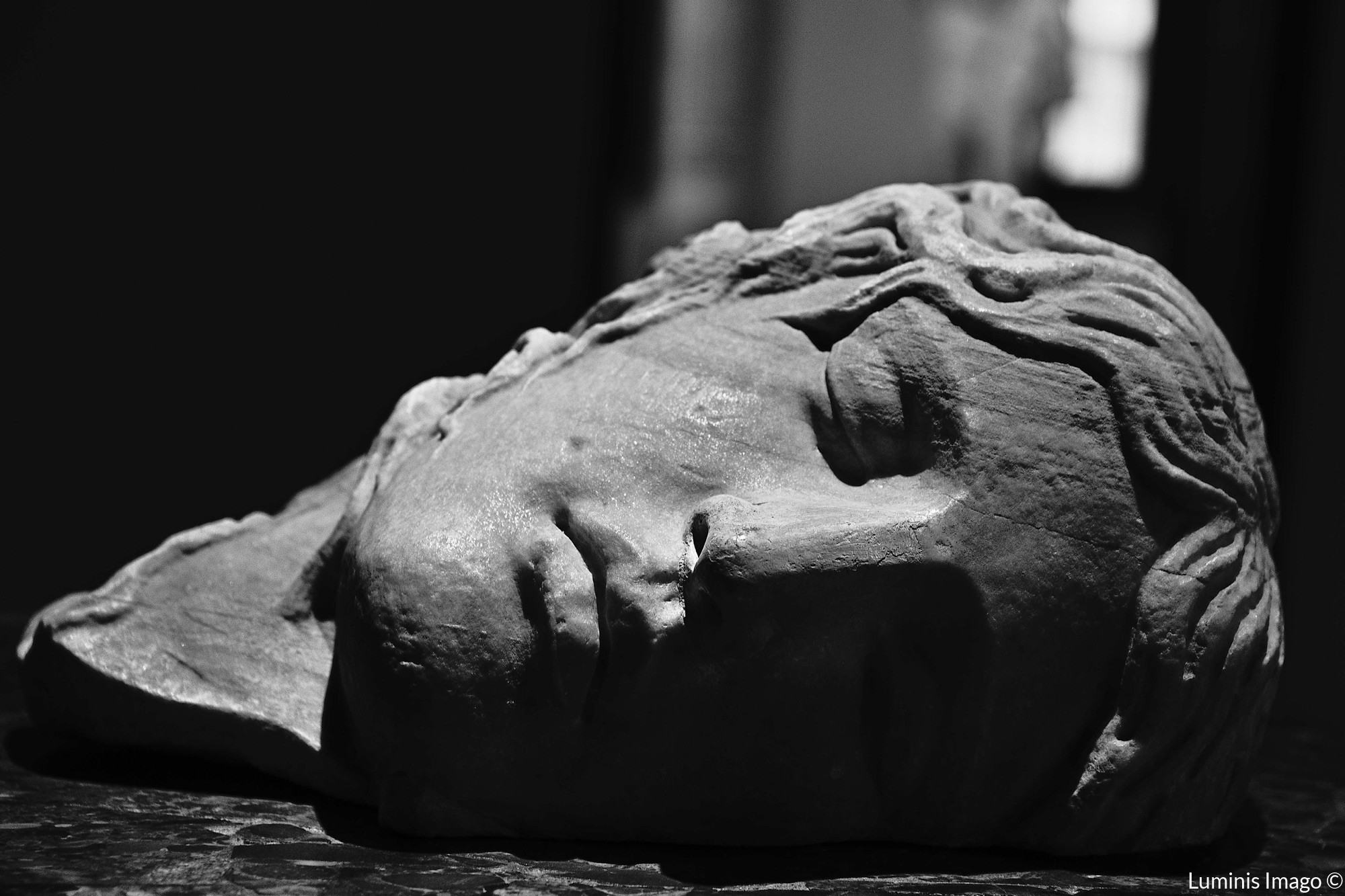
In this post I’ll attempt to address questions of photographic theory that are highly relevant to contemporary visual culture and for my own photographic research. The issues I want to discuss are crucial to understanding what photography is and what characterises its languages in an age when technology contribute decisively to a radical detachment from reality and authenticity.
My objective is not merely theoretical but rather is to outline the program of a visual poetic for my own photography. Though my opinions are subjective, therefore not necessarily shared by everyone, I make an effort to ground them on concepts that are consolidated in photographic theory so that they can be discussed in a shared language.
As anticipated in the title, the main axis of my reflection is the relation of Photography with Time. I will show how Time is an essential dimension of photography at three distinct levels: photographs are documents of the present time, memories of past times, symbols of an absolute Time. I will exemplify my propositions with my own photographs taken from sections of this blog relating to documents, memories, art and urban landscape. And finally, I will trace conclusions in the spirit of making my reflection relevant in the contemporary visual culture as well as by connecting my visual poetic to an ethical approach to photography.
Photography as document
At a first level, it is a matter of fact that any photograph is a representation of something that happened or existed somewhere at a certain time and for a certain duration. This is what might be called the indexical nature of photography (Krauss), ie the fact that a photograph is a footprint of something that really existed somewhere at a certain time. To be noted that this characteristic makes photography radically different from any form of generative artificial intelligence aimed at producing images of something that never existed in the real world. Later in this article I’ll touch the visual and ethical implications of such a difference.
Indexicality is particularly evident in documentary photography (though it is present in any photograph) and is usually emphasized through a realistic and direct photographic language.
The gallery Documents of our Time shows examples of photographs with a documentary purpose.


Photography as memory
At a second level of analysis, photographs have the social function of freezing and preserving instants of time that are deemed worth recording. This is why it has been said, since the very beginning of photography, that photographs are alike to mirrors with memory: like mirrors, they reflect the sensitive world but, different from mirrors, they durably retain the representation of the captured time.
This is a crucial difference compared to memory. A mental reminiscence recalls to the present something that however remains in the past: even if it causes feelings and thoughts, only these latter are in the present, while the thing remembered remains definitely in the past.
Photography has a different way of functioning: that object called a photograph that is observed is a material object here and now; it is a object that, in recollecting a memory from the past, is also a tangible/visible thing in the present. Photographs come from the past but have a present and actual consistency; they are a physical and living extension from past to present, making the past be lived in the present; they are a bridge from past to present, and vice versa, linking lived experiences to actual feelings, history to contemporaneity, the dead to the living. This is what I mean by photography as a form of memory.
To be clear, I’m not making reference to photographs that are merely a “record” of events, such as family, travel, wedding photos; rather, I refer to a type of photography that is deliberately intended to evoke emotions and thoughts related to memories and life experiences (also referred to as Erlebnis), such as reminiscence and nostalgia, also by way of an evocative and indirect photographic language.
The following photographs from Memories exemplify that kind of language.


Photography as a symbolic language
And this leads to the third level of the time-photography relationship, the more abstract but no less relevant to the photographic practice. The starting point is that any photograph divides the timeline into two segments: the first one before the photo was taken, from present to back in the past; and the second one from present towards the future (Berger).
From this it follows that an observer looking at a photograph enters (consciously or not) a time dimension where that particular point in time captured through the camera— that document of something that existed at a certain time and that has been frozen in the photographic memory— is a point in its own line of time, different from the observer’s time.
In other words, when an observer looks at a photograph in her present time, her timeline crosses the photograph’s distinct timeline. From this crossing and overlapping of timelines results a particular state of mind consisting of an all-embracing time dimension going beyond the linear past-present-future timeline, a dimension that could be called timelessness or absolute time. A loop in time, a suspension in which photographs can evoke reflections and feelings outside the day-by-day experience. Concepts of Ephemerality, Inscrutability, Transcendence can be translated through images suggesting a world of meanings hidden behind the visible world, not directly visible but just guessed in the same way as one can put a glance at the extreme borders of a wall in an attempt to spot what stays beyond, without completely and clearly distinguishing it (Galimberti, Heidegger). The associated sensations are at once of absence and presence, veiled and unveiled. I call this state of mind the experience of the metaphysical silence, because silent (not clear, not univocal, not explicit) are the answers we may find to such fundamental questions about existence and meaning. This is where photography goes beyond document and memory to become an exploration of symbols, a reflection on the meaning and purpose of existence.
No single language is univocally associated with this kind of photography as both the realistic and the evocative are suitable. What matter the most is that the use of images is rather conceptual, requiring a second or third level of interpretation going beyond the immediacy of the subjected image.
See my galleries Roma and Melancholy of the Ancient World.


Roma, Melancholy of the Ancient World
Conclusions: Time in the contemporary visual culture and the role of photography
Humanity is living in a disconnection of images from time as never experienced before. The internet and social networks are producing an uninterrupted proliferation of images whose existence is instantaneous: in the very moment when images come into existence, they join a huge mountain of forgotten images (Fontcuberta). In this continuous flow of images, past and future are lost and time is annulled in an eternal instantaneous present.
The current developments of artificial intelligence applied to the production of images modify further our culture of images: these are no longer proof of reality, no longer provide memory, no longer express meaning. The very concept of time has radically changed, putting humanity in an eternal present without history and without project, deprived of hook to actual reality and of search for meaning (Byung-Chul Han).
In a world of unreal and inauthentic images, photography can still perform a crucial function in reconnecting human existence with time. To do so, photography must adopt a comprehensive ethic based on respect for truth, revitalisation of memory, nurturing of the human need for meaning and transcendence. Borrowing and adapting from Heidegger’s terminology, photography as a form of art should replicate the tripartite structure of temporality of the human being as Dasein: the cure of the present time, in documenting the truth of what is and of what isn’t; the cultivation of the past time, by preserving memories reconnecting to the origins; and the projection into the future in the search for meanings unveiled by the world seen as a source of symbols. To serve these functions, photography has at its hands multiple languages, from documentary to evocative to symbolic. None of them intrinsically superior to the other. What matters is consistency between the general function of photography, the purpose pursued in practising it, and the language chosen to express visual intentions.
***
While comments and reactions to this article are very much welcome, I intend to further develop in future posts several concepts sketched here. For example, I want to explore how the monochrome language is particularly suitable for visually representing the three time dimensions and the ethical approach outlined so far.
References
What follows is not a bibliography of the topic but rather a list of sources that most inspired me to the thoughts that are the background to this article and are mentioned in the text.
Berger J., Understanding a Photograph, Penguin, 1967 – a seminal text on reading and interpreting photographs with key concepts on the photography-time relationships.
Byung-Chul Han: Umbrüche der Lebenswelt (trad.it. Le non cose – Come abbiamo smesso dì vivere il reale, Einaudi 2022) – a contemporary philosophers critical of how technologies modify our way of perceiving and experiencing the reality
Fontcuberta J., La furia de las imágenes, (trad. it. La furia delle immagini, Einaudi 2018) – a maître à penser of contemporary photography, this book is fundamental for understanding the role of photography in the contemporary age
Galimberti, U., La terra senza il male. Jung dall’inconscio al simbolo, Feltrinelli 1984 – this is a very personal choice: an introduction to Jung and to Existentialism, very relevant for the reflections on symbols and language
Heidegger M., Holzwege (trad.it Sentieri interrotti, La Nuova Italia 1968) – it contains an essay, The origins of Art, where the most influential existentialist philosopher explains his own aesthetic theory in relation with his own philosophy
Krauss R., Le Photographique (trad.it. Teoria e storia della fotografia, Bruno Mondadori 1996) – a fundamental text on photographic theory and history
Leave a Reply